
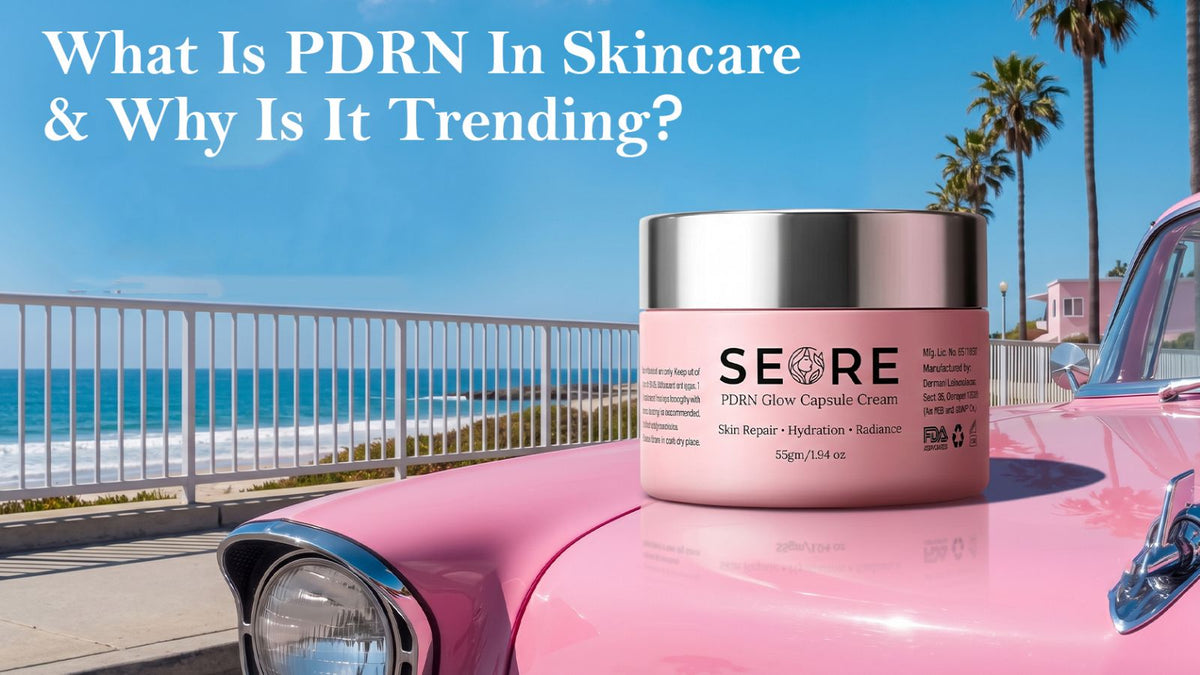
What Is PDRN In Skincare & Why Is It Trending?
Scroll through any Korean beauty forum or skincare reel this year and you'll run into three letters again and again: PDRN. It shows up in creams, serums, sheet masks, and even in dermatology clinics, usually next to words like "regeneration" and "barrier repair." For most people though, the actual meaning behind the buzz stays a little fuzzy. Is it a vitamin? An acid? Something built in a lab?
PDRN itself isn't new. It has been studied in medicine for decades, long before it ended up in a jar of moisturizer. What's new is how fast it has moved from clinical settings into everyday routines, first in Korea and now, increasingly, in India. This piece walks through what PDRN actually is, how it works on skin, what current research does and doesn't support, and how you might think about adding it to your own shelf.
What Is PDRN in Skincare?
PDRN stands for polydeoxyribonucleotide. In plain terms, it's a fragment of DNA, purified and broken down into short chains that are small enough for skincare formulas to work with.
The DNA used to make PDRN has traditionally come from fish sources (commonly salmon or trout milt), though newer plant-derived versions, extracted from cultured roots such as ginseng, are also being developed as sustainable alternatives.
It's worth separating two very different worlds here. In clinical and aesthetic medicine, PDRN is used as an injectable, administered by a trained professional for tissue repair and skin revitalisation. In cosmetics, the ingredient is formulated at a much lower concentration and delivered topically, most commonly through a PDRN cream, along with serums and masks. Most pdrn products sold for home use fall into this second category, and they are built to support the skin's surface rather than to replicate an in-clinic procedure. That distinction matters, and it's one every buyer should keep in mind before comparing claims across products.
How Does PDRN Work On Skin?
On a cellular level, PDRN is understood to interact with adenosine receptors on skin cells. In simple terms, this signalling is thought to encourage cells to behave the way they do when skin is actively healing itself, ramping up processes tied to renewal rather than sitting passively on the surface like a typical moisturising ingredient.
- It supports the skin's natural repair process by supplying the raw material (nucleotides) that cells use during renewal.
- It's associated with encouraging skin regeneration, particularly at the level of fibroblast and keratinocyte activity, the cells responsible for producing collagen and refreshing the skin's outer layer.
- Over consistent use, it's linked with helping skin look and feel healthier overall, rather than delivering an overnight transformation.
It's important to be upfront that most of this mechanism has been documented in laboratory and clinical research, often using injectable or higher-concentration PDRN. Topical, cosmetic-grade formulas are working with the same ingredient family, but at gentler concentrations meant for daily use.
What Are The Benefits Of PDRN For Skin?
Based on the way PDRN behaves in research and how it's positioned in modern formulations, the benefits most commonly associated with it include:
- Supporting skin regeneration and cell turnover
- Helping improve the appearance of skin texture over time
- Supporting hydration and overall skin barrier health
- Potentially helping soften the look of fine lines with regular use
- Leaving skin looking smoother, calmer, and more refreshed
None of this is meant to be read as a medical claim. These are the outcomes people typically look for when they add a PDRN-based product into a routine, and they align with what current research suggests about the ingredient's role in supporting skin's own repair processes.
Why Is PDRN Trending In Korean Skincare?
A few things are converging at once. Regenerative skincare, formulas built around supporting skin's own repair and renewal rather than simply masking concerns, has been gaining ground globally, and Korea's beauty industry has always been quick to translate emerging dermatological ingredients into consumer-friendly formats. PDRN fits that pattern closely: it started in medical research, moved into aesthetic clinics, and is now being reformulated for daily topical use.
That shift is exactly why so many searches now revolve around pdrn cream in Korea, as people look for the original formulations behind the trend before deciding what to bring into their own routine.
Interest is growing well beyond Korea's borders too. Search activity and product launches around pdrn skincare in india have picked up noticeably over the past year, as more Indian brands and consumers explore what the ingredient can offer.
There's also a practical reason a PDRN cream can be formulated to suit Indian skin needs specifically. India's climate isn't one thing, it swings between intense heat, high humidity, and heavier pollution exposure in a lot of cities, and all of that puts additional stress on the skin barrier. A well-formulated PDRN product, adapted with this environment in mind rather than simply repackaged from a colder, drier climate, is likely to perform more consistently here. You'll find PDRN worked into a few different formats, but a leave-on PDRN cream tends to be the most practical choice for daily use, since it doubles up as a moisturising step rather than adding an extra layer to a routine, alongside lighter serums and occasional masks for anyone who wants to layer more.
PDRN vs Polynucleotides: Are They The Same?
PDRN and polynucleotides (PN) get used almost interchangeably in a lot of marketing copy, but they aren't quite the same thing. Both are DNA-derived ingredients that work through similar cellular pathways, but they differ in molecular size. PN refers to longer DNA chains, while PDRN is made up of shorter, more fragmented strands.
That size difference is the main reason the two terms get confused so often, they come from the same source material and are talked about in almost identical language around "regeneration" and "repair." In practice, the shorter chain length of PDRN is generally associated with easier absorption into topical formulas, while PN, being a larger molecule, is more commonly used in injectable treatments where it's delivered directly beneath the skin. Both are considered to work in broadly similar ways, but they aren't a straightforward one-to-one swap, and it's reasonable to expect slightly different performance from each depending on how a product is formulated.
Can PDRN Be Used With Other Skincare Ingredients?
Yes, and in most routines it works better as part of a lineup than on its own. Worth knowing here: our PDRN cream already comes formulated with hyaluronic acid and niacinamide built in, so you're not necessarily reaching for separate products to get that combination. Here's how it tends to pair with a few staples, and how to sequence it in a routine.
PDRN + Hyaluronic Acid
Hyaluronic acid handles surface-level hydration while PDRN works on supporting the skin's deeper repair processes, which is why the two work so well together. A simple way to layer them is to start with a hyaluronic acid mask once or twice a week to prep and plump the skin, then follow with your PDRN cream, since it already carries hyaluronic acid in the formula and seals that hydration in as one of the last steps.
PDRN + Niacinamide
Niacinamide is well known for supporting barrier function and helping even out the look of skin tone, and it's also already part of the same PDRN cream. If you're using a separate niacinamide toner or serum as well, apply that first on cleansed skin, then finish with the PDRN cream, applying it last so it can lock both ingredients in together rather than adding an extra standalone step.
PDRN + Centella Asiatica
Centella asiatica is one of the most trusted calming ingredients in Korean skincare, and it's frequently paired with PDRN in newer formulas. This combination is especially useful for anyone with reactive or easily irritated skin, since so many centella asiatica skin care products are built specifically to soothe while other actives do their work.
PDRN + Glutathione
Glutathione is best known as an antioxidant, and it's often included in formulas aimed at brightening and evening out skin tone. Paired with PDRN, the combination leans toward supporting a more even, refreshed complexion over time, rather than targeting any single concern in isolation.
Is PDRN Suitable For All Skin Types?
Broadly, yes, though how it's used can shift a little depending on your skin's needs.
- Dry and dehydrated skin: PDRN's support for barrier health and hydration tends to make it a genuinely good fit here.
- Sensitive or stressed skin: Well-formulated, fragrance-light PDRN formulas are often tolerated well, though patch testing is still worth doing (more on that below).
- Mature skin: The regenerative angle lines up closely with what a lot of people are already looking for from anti-aging routines.
- Normal and combination skin: PDRN layers easily here without disrupting oil balance, making it simple to add without overhauling an existing routine.
How To Add PDRN To Your Skincare Routine
A PDRN cream is generally applied on cleansed, slightly damp skin, after toner and any lighter hydrating steps, as one of the last layers in a routine since the cream itself is what locks everything in. Many people use it both morning and night, though if you're new to the ingredient, starting once daily (evenings tend to be the easier entry point) is a sensible way to see how your skin responds before building up.
PDRN cream tends to pair well with hydrating, barrier-supporting steps applied before it, think gentle cleansers, hydrating toners, or an occasional hydrating sheet mask, rather than anything overly exfoliating or acid-heavy used right beforehand.
Daytime sun protection isn't optional here, it's part of making the rest of the routine actually work. Skin that's in an active repair phase is more sensitive to UV stress, so pick a korean sunscreen for sensitive skin if your skin leans reactive, and check that it's rated at least
sunscreen spf 50 pa+++ for dependable coverage against India's stronger sun exposure through most of the year.
Is PDRN Safe For Skin?
For topical, cosmetic-grade use, PDRN is generally well tolerated, and it doesn't carry the same risk profile as stronger active ingredients like retinoids or high-strength acids. That said, "generally well tolerated" isn't the same as "guaranteed to suit everyone," and a few practical points are worth keeping in mind.
Formulation and product quality matter more than the ingredient name on its own. How PDRN is purified, at what concentration it's used, and what it's combined with all affect how a product performs and how your skin responds to it, which is why sourcing from a brand that's transparent about its formulation is worth prioritising.
As with any new active, patch testing before working a PDRN product into your full routine is a good habit. Apply a small amount to an inconspicuous area, like the inside of your forearm, and wait 24 to 48 hours before introducing it to your face.
Does PDRN Really Work? What Does Science Say?
This is the part worth slowing down for, because a lot of skincare marketing borrows the language of "clinically proven" without much behind it. PDRN is a little different in that it does have a genuine research history, though it's important to understand exactly what that research covers.
What Laboratory Studies Suggest
Cell-based studies have looked at how PDRN affects fibroblasts and keratinocytes, the two cell types most responsible for producing collagen and renewing the skin's surface. This line of research has generally found that PDRN can encourage these cells to proliferate and become more active, which lines up with the "regeneration" language used across the category.
What Clinical Studies Have Found
Clinical research on PDRN is more developed in medical and wound-care contexts than in cosmetics specifically. Studies involving injectable PDRN, used in dermatology and wound healing, have reported benefits including faster wound closure, improved tissue repair, and support for skin revitalisation. This research base is a big part of why PDRN earned its reputation before it ever reached a skincare shelf.
What We Know About PDRN And Skin Regeneration
Taken together, laboratory and clinical research point to PDRN playing a genuine role in supporting skin repair processes, largely through its interaction with adenosine receptors and its ability to supply raw material for cell renewal. This is a reasonably well-established mechanism, not a marketing invention.
What Researchers Still Don't Know
What's still thinner is research on topical, lower-concentration, cosmetic-grade PDRN specifically, as opposed to the injectable or higher-strength versions used in most published studies. How closely a daily-use cream replicates those documented effects, and over what timeframe, isn't something the current research base answers with much precision yet.
Understanding The Limitations Of Current PDRN Research
Most of the strongest data comes from wound-healing and clinical aesthetic contexts, not from long-term studies on cosmetic PDRN used at home. That's not a reason to dismiss the ingredient, plenty of well-regarded skincare actives have followed a similar path from clinical research into cosmetic use, but it is a reason to keep expectations realistic and to treat consistent, patient use as the more honest picture of what a topical PDRN product can offer.
Frequently Asked Questions About PDRN:
Q. What does PDRN do for the skin?
A. It's understood to support the skin's natural repair and renewal processes, which over consistent use is associated with a smoother, more refreshed, better-hydrated look.
Q. Is PDRN good for sensitive skin?
A. It's often well tolerated, especially in fragrance-light, minimally formulated products, but sensitive skin should still patch test before adding anything new to a routine.
Q. Can PDRN be used every day?
A. Yes, you can. In fact, it's good to use it twice a day, morning and evening, so your skin gets consistent support around the clock. If you're introducing it for the first time, starting once a day and watching how your skin responds before adding the second application is still a sensible approach.
Q. Is PDRN the same as PN?
A. Not exactly. Both are DNA-derived ingredients that work through similar pathways, but PN is made up of longer DNA chains while PDRN is more fragmented, which affects how each is typically used and absorbed.
Q. Is PDRN suitable for Indian skin?
A. Yes, particularly when the formula is built with local conditions in mind, since heat, humidity, and pollution exposure all place extra demand on the skin barrier that PDRN is positioned to help support.
Q. How long does PDRN take to show results?
A. Most people are advised to expect gradual change with consistent use rather than an overnight effect, generally over several weeks, since PDRN works by supporting skin's own renewal processes rather than delivering an instant surface change.
Q. Do I put moisturizer after PDRN?
A. Not necessarily. A PDRN cream is designed to be one of the last steps in a routine, so it already works as your moisturiser and locks in whatever hydrating steps (like a hydrating sheet mask or toner) came before it. If your skin needs extra richness, a light moisturiser on top is fine, but it isn't required.
Q. What Is the Best Time to Apply PDRN Cream - AM or PM?
A. It's good to apply it twice daily, but night (PM) is when it does its best work. Skin's natural repair and regeneration processes are most active while you sleep, without the interference of sun exposure, pollution, or makeup, so applying PDRN cream at night lets it support that repair window directly. Morning application is still worthwhile for consistency, just follow it with sunscreen.
Final Thoughts
PDRN's rise in skincare isn't just another passing trend built on clever packaging. It's an ingredient with a real, if still developing, research history, and its move from clinical settings into everyday routines follows a pattern a lot of respected activists have taken before it. The honest picture is somewhere in the middle: promising and backed by genuine science, but still best approached with realistic, patient expectations rather than overnight promises.
If you're curious about adding it to your own shelf, look for a well-formulated product suited to your skin type and to the conditions you're actually living in, patch test first, and give it time before judging the results. At SEORE, our PDRN cream is formulated with exactly this in mind, built for Indian skin and climate, so you can start simple and let consistency do the rest.
Read more

Explore beautiful Janmashtami decoration ideas for home, temple and office. Discover simple, creative and budget-friendly ways to decorate for Krishna Janmashtami.
Comparing 5 Korean sunscreens by SPF/PA, ingredients and texture - helping you choose the right daily sunscreen for your skin type and Indian weather.
Leave a comment
This site is protected by hCaptcha and the hCaptcha Privacy Policy and Terms of Service apply.